

So after all the media coverage and KOL shills about Vietnam Crypto regulation, I want to write a more detail piece on the topic. Going deep into what's happening on the ground, responding to misinformation and provide a more nuance view on the current situation. But keep in mind that the topic is also very complex so this is still a simplification.
Fact: Decree 5 for Domestic, Decree 222 for Foreign
First highly confusing part, there are actually 2 different Decrees, Decree 5 and Decree 222, that serve 2 different purposes. Decree 5 is under the authority of the Ministry of Finance, regulating the domestic crypto market. The Decree is crafted in such a way that highly unlikely that any current crypto companies globally can obtain; and I believe it was the intentional. The priority of the Decree 5 is propping up local centralized crypto exchanges (which favors local financial institutions due to the requirement to have at least 2 financial institutions contributing over 35% of the charter capital), enforcing taxation on trading activities, and promoting some form of real world asset tokenization (more on this later). Decree 222 is aimed to structure and regulate the 2 Vietnam International Financial Centers (VIFCs) in Da Nang and Ho Chi Minh City. In its contents, Circular 222 allows companies registed in VIFCs, domestic and foreign, to register and operate ideas that don't fit in other regulations, including Decree 5. However, with a caveat is that these companies very likely won't be able to serve local Vietnamese customers. The VIFCs are structured like free trade zones, companies get preferential treatments in terms of taxes, paperwork, compliance, in exchange for targeting foreign customers, attracting foreign capital, and gaining attention towards Vietnam.
Myth: the adoption estimate
Next, there is a narrative being built around Chainalysis Report The 2025 Global Adoption Index which puts Vietnam at 4th place on the index. I personally think the lack of open data and the highly speculative tracking methodology based on web traffic patterns mean that the index should be taken with a grain of salt. It might be useful as a reference combining with on-the-ground intelligence and trials. However, a lot of people are taking advantage of this report to "lure" crypto companies into setting up operations in Vietnam and paying them unreasonable amount of service fees while providing subpar results. If you ask me how would I describe Vietnam Crypto Market, here are my thoughts:
- In terms of retail usage, none of the figures you see online are accurate. There is a "20 million user base" figure being thrown around (or "21% of the population") but that's not possible. Figures are based on a flawed 2020 poll by World Economic Forum and Statista (which only polled 1000 - 4000 respondents and extrapolate upwards, no open data for verification on bias and makeup of respondents). Below is the picture from the article. The "20 million user base" claim has been circulating since 2021 until today 2026 so it's a wild guess. I am trying to push for a more grounded study on retail usage with open data, and we can wait for official numbers coming out at some point next year 2027.
 ↑ Link to poll
 - In terms of institution adoption, there is basically almost zero since before 2025, crypto wasn't "legal" in Vietnam (existed in the grey zone) so no serious institution would be looking at it. RWA tokenization might be on the horizon since the VIFCs would allow some form of assets (potentially securities) to be tokenized by companies registered there. However, attractiveness of these tokens remain to be seen. I am personally not a fan of the local securities/commodities market.
- In terms of developers/builders, I think Developer Report is an excellent source and you can see that Vietnam is not really at the top yet. There are talents for sure but not as numerous as claimed by some; I have heard figures like 50,000 crypto developers which is nonsense. My experience on the ground is that developers/builders are not keen on crypto at the moment, most are turning their attention to AI.
Fact: Large crypto events in Vietnam is extremely low ROI
There have been lots of hype on organizing crypto events in Vietnam, especially Da Nang because the local government wants to attract lots of attention to the small tourist city. I don't think any serious economic activities would happen there, maybe a smaller tech sector can grow out from there but Ho Chi Minh City is the economic center of Vietnam. Hanoi (the capital) is the runner up in terms of an economic center, however, it is the political capital for regulatory advocacy activities. Crypto events in Vietnam are full of headaches, lots of permits to obtain and almost certainly won't attract the user base that you thought about. Any crypto companies are better off running a small meetup series with a local ambassador/super fan/representative; much more efficient in terms of budget and you can still target the same user base. Previous major crypto events in Vietnam like GM Vietnam, Super Vietnam and Conviction are not really up to my expectation. I didn't find a lot of reasons to be there. My preference is something like Devcon/nect but local organizers won't be able to make money doing something like that.
And no. I won't host ETH Vietnam just to stumble into that quagmire. But I'm planning a big video telling stories about Vietnamese Ethereum builders.
Myth: Crypto payment would be legal
It's a big NO and a smaller yes. Given Vietnam capital control policy, its concern on the Dong (VND) losing values and the committed stance on the VND being the only legal fiat currency domestically (Decree 5 also doesn't permit tokenizing the VND for domestic market), there is zero chance that the government would let something like crypto payment. Meanwhile, the local payment networks are very sufficient in meeting the local needs; free for retails, cheap for businesses, practically instant settlment. However, within the context of VIFC, I think they definitely would green light (officially) some form of crypto payments for foreigners/tourists coming to Vietnam; but even more nuance is that it might just be an offramp service to pay merchants via local fiat rails.
Local payment rails include primarily NAPAS (debit network for card and interbank, maybe credit soon), VISA (card), Mastercard (card), JCB (card), plus some fintech (but tiny market share). Card and Pay via QR are the two most popular non-cash payment methods. If you have a crypto card running on Visa or Mastercard, you should be able to easily pay locally with no issue and lots of places accepting card nowadays. Pay via QR is more complicated. I find lots of apps claiming they can do this tend to have short life span or poor reliability; and the issue is mostly not technical related. But the upcoming VIFCs probably would improve the Pay via QR experience with crypto, but most likely only for foreigners/tourists.
Fact: Self custody is still legal
A major fear locally has been that every Vietnamese must deposit into the local centralized exchanges. However, it has been confirmed publicly that self custody remains legal. People can keep cryptocurrencies in self-custodial wallets. The definition didn't make a distinction on non-custodial and self-custodial. Non-custodial wallet is something like Privy, Para, Turnkey. Self custodial is your Metamask, Rainbow, Keycard, etc.
Decree 5 states that any trading activities must happen on local crypto exchanges (there seems to be no distinction whether the exchange is a CEX or DEX). If my understanding were correct, Vietnamese trading on any foreign exchanges would be highly illegal, aS iLLeGAl aS gAmBLiNg aNd pR0n. Fine level has been set to a maximum of 200M VND (~US$7,600).
Additional thoughts
I think for non-Vietnamese crypto companies, there won't be any differences with servicing Vietnamese users since liability has been shifted to them in the eyes of the law. However, access to your web app might be blocked.
There are some merits for Vietnamese crypto companies (and possibly foreign as well) to register in VIFCs to take advantage of the unique compliance setup and taxation scheme, provided that there won't be any compliance barriers to be competitive on a global scale. I haven't seen any details on their framework yet; VIFC in Da Nang is frontrunning some small pilot projects but nothing set in stone at the moment.
There are a few local corporate blockchains that will get adopted into government applications serving as a cryptographic layer to harden security, specifically around identity and supply chain tracking. For us crypto builders, their use cases are very irrelevant. These are not public blockchains, even the users won't ever know that they are interacting with it. Could Ethereum make a case!? unlikely for national security reason and domestic political interest.
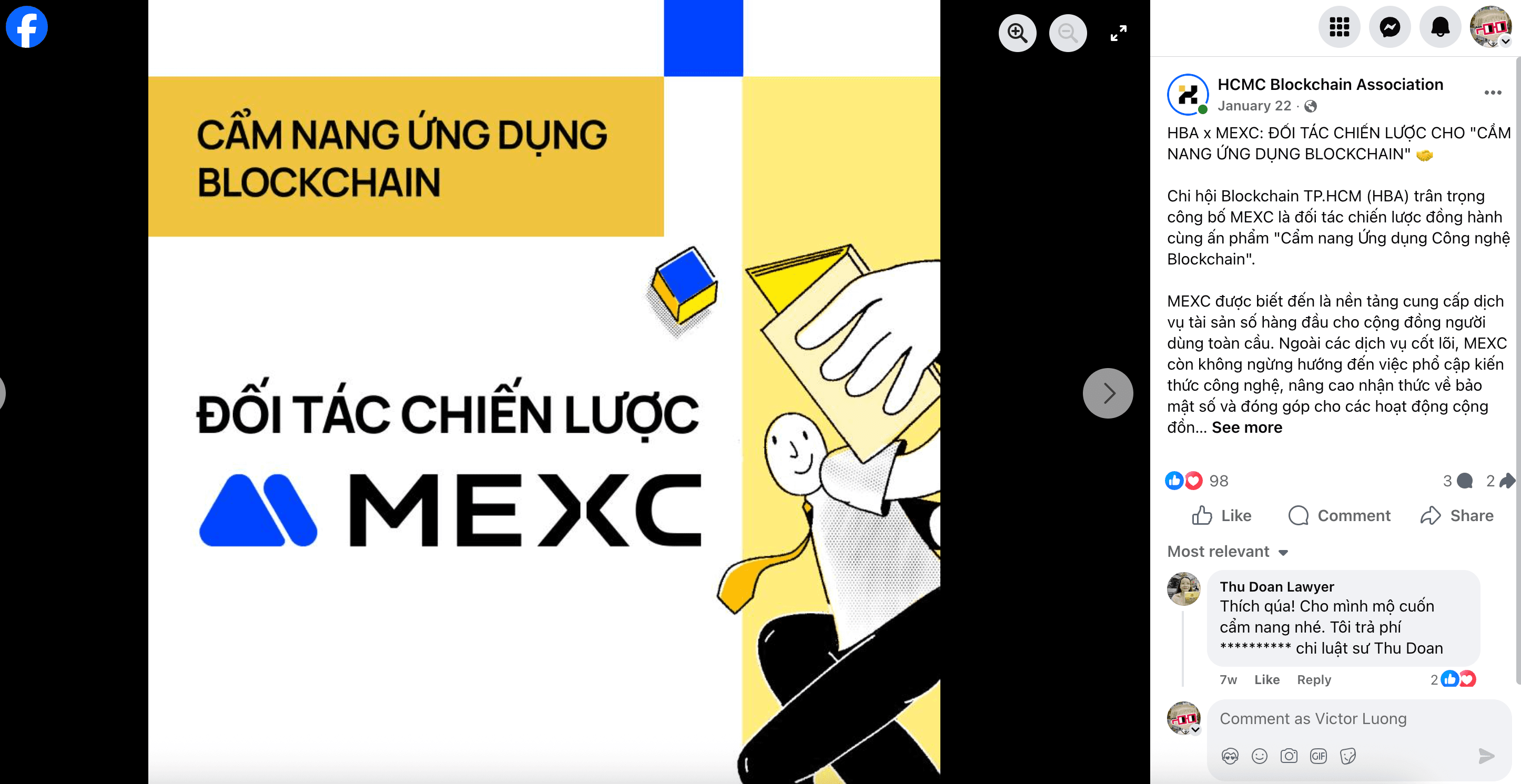
I don't find the local Vietnam Blockchain Association (VBA) and Ho Chi Minh Blockchain Association (HBA) super helpful. Vietnam Blockchain Association is directly related to 1Matrix (one of the above mentioned corporate blockchains) and they seem to advocate for said blockchain primarily with members mostly local financial institutions. Ho Chi Minh Blockchain Association is directly related to Viction, a Layer 1 Blockchain in Nighty Eight ecoystem, which is also not a blockchain I personally would use nor I think they represent the Ethereum values and ethos. I also question their continuous relations with questionable CEXs like MEXC despite them being a known scammy bucket shop that is unregulated anywhere.
There is a new Global On-chain Economy Alliance organization that will set up at the IFC in Ho Chi Minh City; both KyberSwap and Sky Mavis are founding members, which I hope they would advocate for Ethereum builders but only time could tell.

Honestly, I haven't been able to find any organizations worthy enough for me to support publicly at the moment. I do run my own initiatives DeFi.vn and Weth.vn but they are social media driven, with no major backings behind.
So...
I hope this article has been helpful for you to understand more about the Vietnam Crypto Market. I'm happy to elaborate more on the topic, provide my personal opinions on various local matters, exclusively for the Ethereum ecosystem.